At a time of increasing weather volatility, it is no surprise that regulators expect water companies to maintain an intense focus on leakage detection, writes Dineke Fischer, senior executive, Ovarro
Three months after the last drought ended, dry conditions this spring have increased the risk of a summer drought in parts of England, reported the National Drought Group on 19 June 2026.
The latest drought group updated followed a warning from the Environment Agency in March 2026, that England was likely to experience “weather whiplash”, rapid swings between drought and flooding driven by climate change. The same conditions are being seen across much of Europe – Spain, for example, is being increasingly impacted by hydroclimatic volatility, according to researchers.
The challenge for water utilities is therefore no longer simply maintaining infrastructure, but building adaptive, flexible systems capable of responding to increasingly uncertain operating conditions.
For leakage specifically, extreme temperature changes will increase the frequency of conditions such as freeze-thaw events and prolonged dry spells, both of which can cause significant outbreaks of leaks. As such, regulators expect utilities to maintain the intensity of their drought planning year-round.
The good news is the technology to manage these scenarios rapidly and at scale already exists and is evolving at pace, alongside smart solutions that enable more preventative, data-driven leakage detection.
With its latest developments, Ovarro is working with water companies in the UK and worldwide on a three-pronged approach to leakage detection – 24/7 visibility, rapid detection and operational insight:
- Continuous network visibility – loggers and RTUs gives operators real-time awareness of changing network conditions, helping identify anomalies before they escalate into major incidents.
- Fast, accurate leak detection – equally critical during periods of uncertainty. Advanced correlating leak loggers and hydrophones can identify even small, long-running leaks with metre-level accuracy, including on difficult plastic pipes
- Cloud-based analytics platforms – combining acoustic and flow data to prioritise repairs, reduce false positives and identify long-term trends that support proactive maintenance and climate resilience.
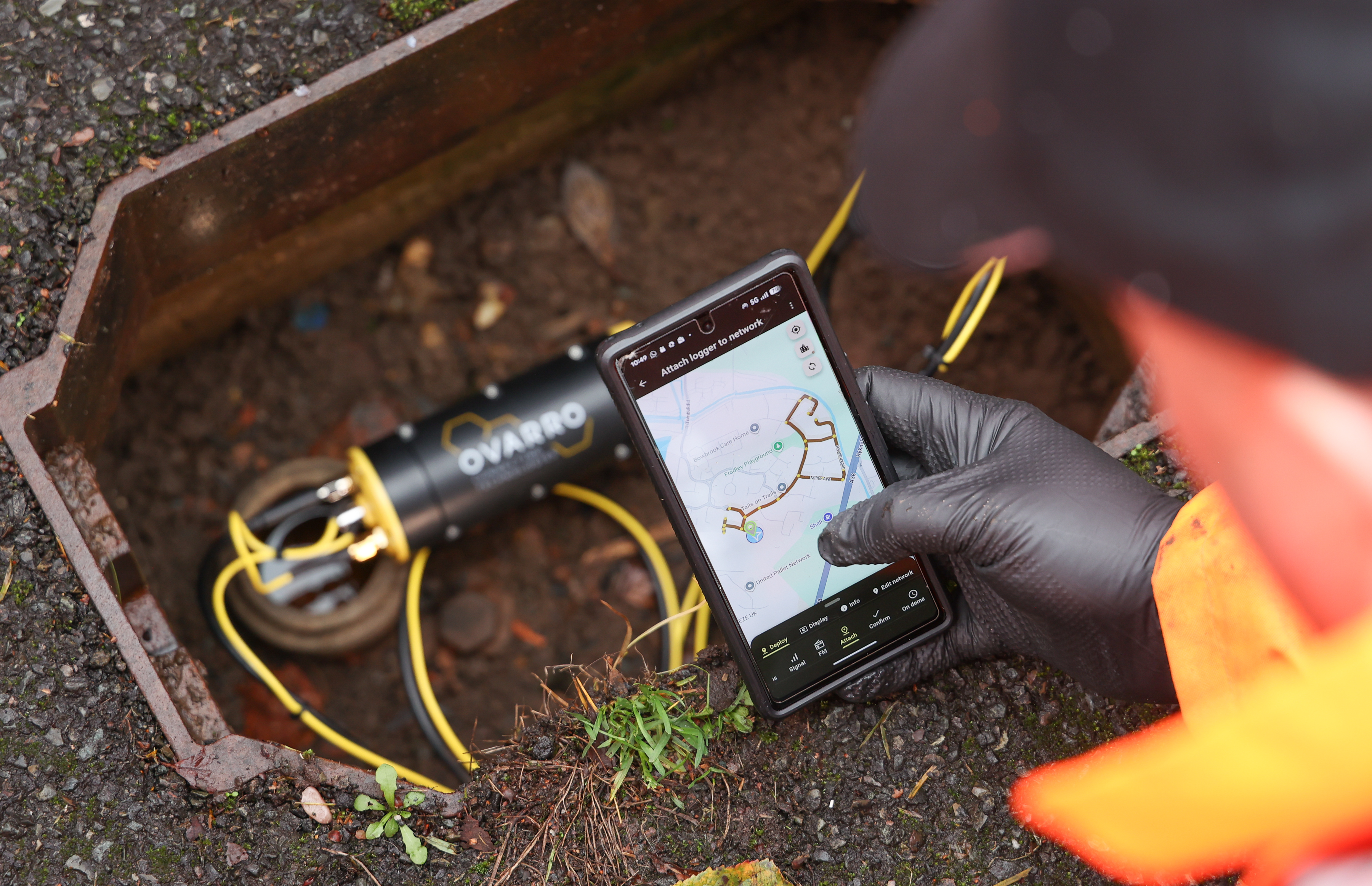
One key digital development from Ovarro combines all three steps – EnigmaREACH, a lift-and-shift correlating hub. By combining a set of loggers, a single app to guide logger placement, retrieval and follow-up, plus automated analytics, EnigmaREACH reduces reliance on manual analysis to speed up the end-to-end leak detection process.
This is particularly valuable during breakout events and during drought conditions, where rapid detection of leaks is essential to protect constrained water supplies. A recent deployment in Paris demonstrates how the toolkit can support drought mitigation.
The Territorial Public Establishment Grand-Orly Seine Bièvre (EPT GOSB) is the largest territory in the Greater Paris metropolitan area. In its first French deployment, EnigmaREACH was able to cover up to 8km of network in a single correlation shot and identified three leaks simultaneously through 60-second sounds samples.
After the first four weeks of use, during which time the loggers were moved across multiple locations, 12 PoIs were raised and 10 leaks found, including long-running small leaks which had gone undetected, and leaking valves.
Managed services
Alongside hardware and software, managed services are also becoming increasingly important to water companies. In this model, specialist providers take responsibility for delivering specific outcomes rather than simply supplying equipment – for example, measurable reductions in water loss.
Ovarro has seen growing global demand for managed services, particularly in leakage detection. LeakNavigator, for example, sees Ovarro’s leakage and data specialists plan logger deployment and provide ongoing analysis, sending PoIs directly to utility field teams via an app. This frees up resource for companies to focus on repairs and preventing water loss.
The challenge for the sector is no longer whether the technology exists to meet regulatory expectations and strengthen drought resilience – but how quickly it can be adopted and deployed at scale.